
Malaysia Property Overhang 2026: Why Homes Aren't Selling
timer
9 minutes read
April 1, 2026
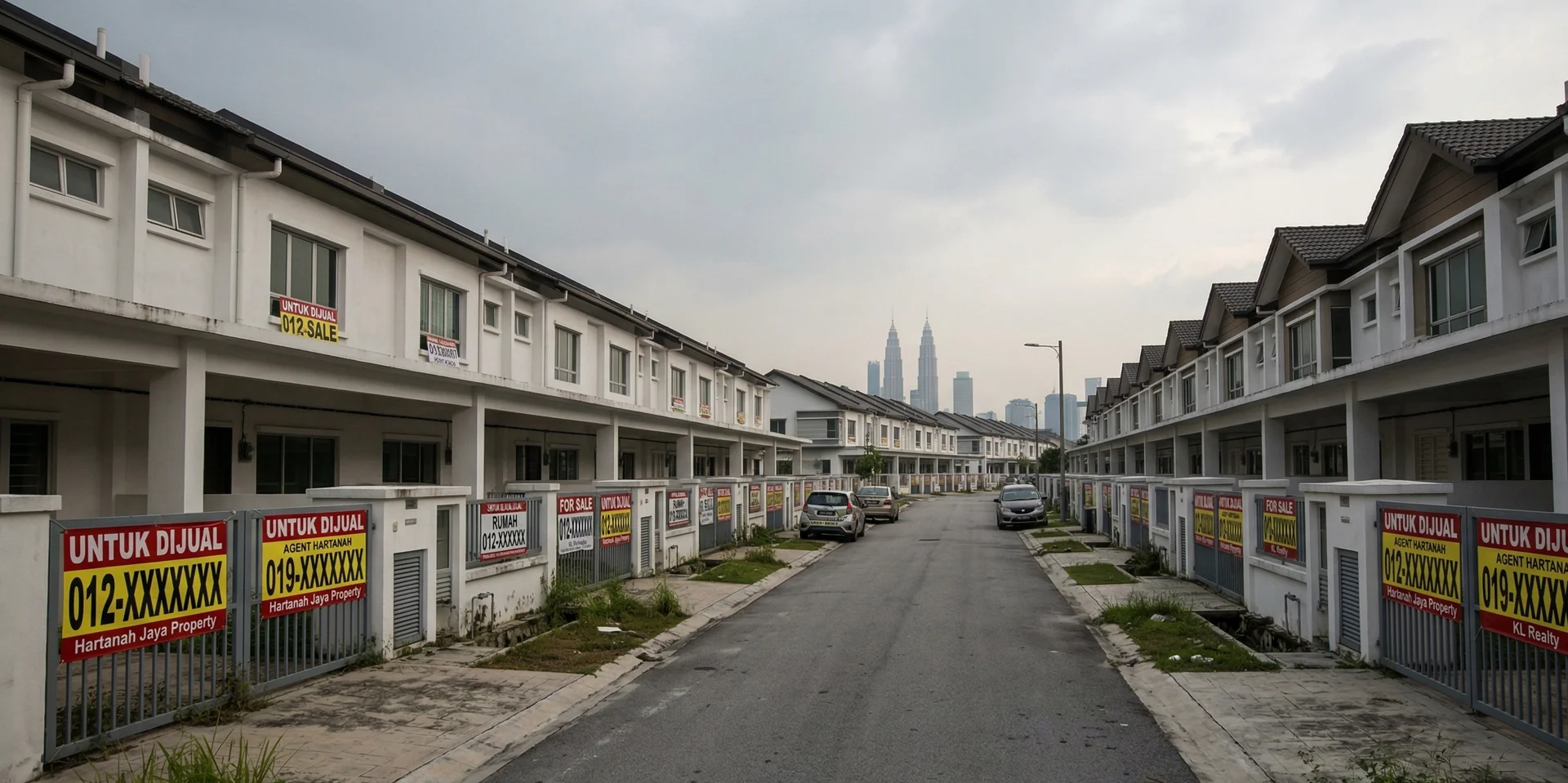
Malaysia's property market ended 2025 under pressure. Sales slowed sharply in the second half of the year, loan rejections climbed, and a large share of completed homes remained unsold — even as developers continued to launch new projects.
The findings come from Rehda Malaysia's Property Industry Survey and Property Sentiment Survey for H2 2025, presented on March 13, 2026. The surveys drew responses from 166 and 107 Rehda members in Peninsular Malaysia respectively, and paint a clear picture: supply is not the core problem. Financing constraints and a policy mismatch between what gets built and what buyers can actually afford are doing the most damage.
Here is what the data shows — and what it means if you are a buyer, a seller, or someone watching the market.
The headline number is hard to ignore. Developers launched 17,971 residential units in H2 2025 — a marginal 0.6% increase from the 17,859 units launched in H1 2025. But only 3,784 of those units were sold, translating into a take-up rate of just 21%.
That is a significant drop from the 38% take-up rate recorded in H1 2025.
By property type, townhouses performed best, with a 60% take-up rate, followed by 1-storey terraced houses at 41%. Serviced residences and higher-density strata properties continued to struggle.
As at December 31, 2025, 60% of developers surveyed reported having unsold completed residential units — with loan rejections, weak demand, and high prices cited as the main reasons. Of those unsold units, 61% were less than one year old, while 22% had been sitting on the market for more than three years.
Rehda Malaysia is calling for a review of the blanket 30% affordable housing allocation required of property developers. The association argues this policy, while well-intentioned, is contributing to the overhang problem rather than solving it.
Rehda Malaysia president Datuk Ho Hon Sang explained that a data-driven approach is needed so supply actually matches local demand.
"A data-driven supply-and-demand concept needs to be adopted so that developers know that what they develop under the Rumah Mampu Milik allocation will achieve the necessary take-up rate," he said.
The mechanics behind this concern come from how cross-subsidies work. When developers are required to include price-controlled affordable units in a project, they offset the resulting losses by raising the prices of the remaining market-rate units.
Rehda Malaysia's immediate past president Datuk N K Tong explained the impact directly:
"If we were given a free hand, pricing would be very straightforward. Let's say units priced between RM500,000 to RM600,000 will be sold in a project. The moment the 30% affordable housing allocation is assigned, developers estimate that it adds RM50,000 to RM100,000 to the selling price."
In practice, that means a project that could launch from RM500,000 may instead open at RM550,000 to RM700,000. That gap — bridged by cross-subsidy — is a core driver of the affordability problem in the market today.
Property Type Share of Unsold Units
2- to 3-storey terraced houses 26%
Serviced residences 19%
1-storey terraced houses 18%
Homes priced between RM500,001 and RM700,000 recorded the highest share of unsold stock — 16% of non-bumiputera units and 13% of bumiputera units on the open market.
It is worth noting that only 11% of survey respondents had price-controlled housing components in their H2 2025 projects. The top challenges those developers faced: difficulty maintaining profitability due to price caps (24%), insufficient demand from target low- to middle-income buyers (17%), and delayed approvals and bureaucratic hurdles (14%).
Even when a buyer is willing and a unit is priced right, financing can derail the transaction. This is one of the most persistent structural problems in Malaysia's housing market right now.
72% of developers reported facing financing issues in H2 2025, with end-financing constraints — where buyers failed to secure housing loans — cited as the primary cause.
The segment hardest hit? Homes priced between RM500,001 and RM700,000, where an average of 38% of transactions failed to secure financing approval.
"If buyers have outstanding credit card balances or excessive debt commitments, it affects their eligibility for housing loans," said Ho. "We encourage developers to guide buyers on managing their finances but, ultimately, if they do not meet the eligibility requirements, it becomes difficult for banks to approve the loan."
Tong added that housing affordability cannot be assessed on property prices alone. Financing access is equally critical — and equally broken for a significant slice of the market.
He suggested a parallel solution: "Perhaps banks should consider allocating about 30% of their mortgage portfolios to affordable loans, so they work harder to accommodate those who need help."
If you are a buyer worried about your borrowing eligibility, speaking to a licensed financial advisor or mortgage specialist before shortlisting properties is strongly recommended — not after.
For those already searching, the [MyRumahBaru property map] lets you filter available units by price range and location across Peninsular Malaysia.
The survey provides a useful snapshot of active buyer demographics. Purchasers aged 29 to 44 made up the largest share of homebuyers at 48%, followed by those aged 45 to 60 at 32% — reflecting demand from young families and upgraders rather than first-time buyers.
Local buyers dominated, representing 74% of transactions.
Foreign demand remained subdued. 64% of developers expect higher stamp duties of between 4% and 8% on foreign buyers to dampen overseas demand, reinforcing the market's reliance on domestic purchasers going forward.
Launch activity was geographically concentrated. Properties priced below RM500,000 were most commonly launched in Perak, Melaka, Kedah, Terengganu, and Negeri Sembilan. Launches in the RM500,001 to RM700,000 range were concentrated in Segambut, Kuala Lumpur.
In KL specifically, land scarcity is reshaping the development pipeline. Rehda Federal Territories (Kuala Lumpur) branch chair Carrie Fong noted that the city is likely to shift away from conventional greenfield launches toward redevelopment and adaptive reuse.
"Kuala Lumpur is behind Johor, Perak, and Selangor in terms of transaction volumes, probably owing to land scarcity and rising land values. I foresee that the city will gradually move towards redevelopment, adaptive reuse, and repurposing," she said.
Despite softer sales in H2 2025, developers have not pulled back entirely. 47% of developers plan to launch projects in H1 2026, with Rehda projecting approximately 5,015 landed residential units and 12,669 strata residential units to come to market in the first half of the year.
Those holding back cited unfavourable market conditions, approval delays, higher unsold stock, and weaker demand in specific locations.
55% of developers plan to expand their land bank in the next 12 months, and 45% expect capital expenditure to increase — suggesting that, despite short-term caution, the sector is betting on longer-term demand recovery.
Industrial property has also emerged as a leading growth area, with developers increasingly eyeing opportunities in logistics, manufacturing, and data-related sectors.
The broader economic backdrop is more stable than the sales figures might suggest.
GDP growth exceeded 5% in Q4 2025
The OPR (Overnight Policy Rate) is stable at 2.75%, keeping mortgage rates manageable
Construction costs rose 3–6% in H2 2025, driven by materials, labour, and expanded SST — but Ho noted this appears manageable for the near term
"Based on this, we expect it to be the scenario for 2026," Ho said.
Developers expect sales performance to improve gradually — from below 25% at three months post-launch, rising to between 25% and 50% at the six-month mark.
Take-up rates fell from 38% in H1 2025 to 21% in H2 2025 — a sharp reversal driven primarily by financing constraints and price mismatches
38% of transactions in the RM500k–RM700k range failed to secure a loan — the most problematic price band in the market
The 30% affordable housing allocation is adding RM50k–RM100k to market-rate unit prices through cross-subsidisation — Rehda is pushing for a data-driven alternative
Townhouses are the standout performer with a 60% take-up rate; serviced residences remain slow
Industrial property is the growth segment to watch as logistics and data-centre demand rises
GDP growth and a stable OPR provide a supportive backdrop — the market is not in freefall, but structural reforms are needed
[Malaysian property market faces a reality check: why developers are pulling back]
[NAPIC H1 2025 Report: Malaysia's property market at a crossroads]
[How to buy your first home in Malaysia: a complete guide for young professionals]
Q: Why are so many new homes in Malaysia unsold in 2025? A: The main reasons are loan rejections, high property prices driven by cross-subsidisation of affordable units, and a mismatch between what is built and where genuine demand exists. Rehda's H2 2025 survey found that 60% of developers had unsold completed residential units as at December 31, 2025, with financing constraints being the single biggest cause.
Q: Which property types are selling fastest in Malaysia right now? A: Townhouses recorded the highest take-up rate at 60% in H2 2025, followed by 1-storey terraced houses at 41%. Serviced residences and mid-to-high-rise strata units are moving more slowly, with serviced residences making up 19% of total unsold stock.
Q: How does the 30% affordable housing requirement affect property prices in Malaysia? A: When developers are required to include price-controlled affordable units, they typically offset their losses by raising prices on the remaining units. According to Rehda, this cross-subsidy adds approximately RM50,000 to RM100,000 to the selling price of market-rate units in the same project, pushing some launches from the RM500,000 range into the RM600,000–RM700,000 band.
Q: What is the home loan rejection rate in Malaysia in 2025? A: For homes priced between RM500,001 and RM700,000 — the segment with the highest launch activity — an average of 38% of transactions failed to obtain financing approval in H2 2025, according to Rehda's Property Industry Survey. Common causes include excessive debt commitments and outstanding credit balances affecting buyer eligibility.
Q: Will the Malaysian property market recover in 2026? A: Conditions are mixed but not alarming. GDP growth exceeded 5% in Q4 2025 and the OPR remains stable at 2.75%. Rehda projects 47% of developers will launch in H1 2026, and expects take-up rates to improve gradually from below 25% at three months to between 25% and 50% after six months. However, structural issues around financing access and policy-driven price inflation remain unresolved.
Q: Is now a good time to buy a property in Malaysia? A: That depends on your financial position, preferred location, and property type. Macro conditions — stable interest rates and solid GDP growth — are broadly supportive. However, loan rejection rates remain high, so assessing your credit health before committing is essential. Consulting a licensed financial advisor and speaking with a registered estate negotiator (REN) before making a decision is recommended.
Written by MRB Editorial Team | Source: Rehda Malaysia Property Industry Survey and Property Sentiment Survey, H2 2025 (presented March 13, 2026) | Review recommended after Q2 2026 NAPIC data release
The findings come from Rehda Malaysia's Property Industry Survey and Property Sentiment Survey for H2 2025, presented on March 13, 2026. The surveys drew responses from 166 and 107 Rehda members in Peninsular Malaysia respectively, and paint a clear picture: supply is not the core problem. Financing constraints and a policy mismatch between what gets built and what buyers can actually afford are doing the most damage.
Here is what the data shows — and what it means if you are a buyer, a seller, or someone watching the market.
Take-Up Rates Fell Sharply in H2 2025
The headline number is hard to ignore. Developers launched 17,971 residential units in H2 2025 — a marginal 0.6% increase from the 17,859 units launched in H1 2025. But only 3,784 of those units were sold, translating into a take-up rate of just 21%.
That is a significant drop from the 38% take-up rate recorded in H1 2025.
By property type, townhouses performed best, with a 60% take-up rate, followed by 1-storey terraced houses at 41%. Serviced residences and higher-density strata properties continued to struggle.
As at December 31, 2025, 60% of developers surveyed reported having unsold completed residential units — with loan rejections, weak demand, and high prices cited as the main reasons. Of those unsold units, 61% were less than one year old, while 22% had been sitting on the market for more than three years.
The Affordable Housing Policy Is Pushing Prices Up
Rehda Malaysia is calling for a review of the blanket 30% affordable housing allocation required of property developers. The association argues this policy, while well-intentioned, is contributing to the overhang problem rather than solving it.
Rehda Malaysia president Datuk Ho Hon Sang explained that a data-driven approach is needed so supply actually matches local demand.
"A data-driven supply-and-demand concept needs to be adopted so that developers know that what they develop under the Rumah Mampu Milik allocation will achieve the necessary take-up rate," he said.
The mechanics behind this concern come from how cross-subsidies work. When developers are required to include price-controlled affordable units in a project, they offset the resulting losses by raising the prices of the remaining market-rate units.
Rehda Malaysia's immediate past president Datuk N K Tong explained the impact directly:
"If we were given a free hand, pricing would be very straightforward. Let's say units priced between RM500,000 to RM600,000 will be sold in a project. The moment the 30% affordable housing allocation is assigned, developers estimate that it adds RM50,000 to RM100,000 to the selling price."
In practice, that means a project that could launch from RM500,000 may instead open at RM550,000 to RM700,000. That gap — bridged by cross-subsidy — is a core driver of the affordability problem in the market today.
What the Unsold Stock Looks Like by Type and Price
Property Type Share of Unsold Units
2- to 3-storey terraced houses 26%
Serviced residences 19%
1-storey terraced houses 18%
Homes priced between RM500,001 and RM700,000 recorded the highest share of unsold stock — 16% of non-bumiputera units and 13% of bumiputera units on the open market.
It is worth noting that only 11% of survey respondents had price-controlled housing components in their H2 2025 projects. The top challenges those developers faced: difficulty maintaining profitability due to price caps (24%), insufficient demand from target low- to middle-income buyers (17%), and delayed approvals and bureaucratic hurdles (14%).
Loan Rejections Are Blocking Sales
Even when a buyer is willing and a unit is priced right, financing can derail the transaction. This is one of the most persistent structural problems in Malaysia's housing market right now.
72% of developers reported facing financing issues in H2 2025, with end-financing constraints — where buyers failed to secure housing loans — cited as the primary cause.
The segment hardest hit? Homes priced between RM500,001 and RM700,000, where an average of 38% of transactions failed to secure financing approval.
"If buyers have outstanding credit card balances or excessive debt commitments, it affects their eligibility for housing loans," said Ho. "We encourage developers to guide buyers on managing their finances but, ultimately, if they do not meet the eligibility requirements, it becomes difficult for banks to approve the loan."
Tong added that housing affordability cannot be assessed on property prices alone. Financing access is equally critical — and equally broken for a significant slice of the market.
He suggested a parallel solution: "Perhaps banks should consider allocating about 30% of their mortgage portfolios to affordable loans, so they work harder to accommodate those who need help."
If you are a buyer worried about your borrowing eligibility, speaking to a licensed financial advisor or mortgage specialist before shortlisting properties is strongly recommended — not after.
For those already searching, the [MyRumahBaru property map] lets you filter available units by price range and location across Peninsular Malaysia.
Who Is Actually Buying?
The survey provides a useful snapshot of active buyer demographics. Purchasers aged 29 to 44 made up the largest share of homebuyers at 48%, followed by those aged 45 to 60 at 32% — reflecting demand from young families and upgraders rather than first-time buyers.
Local buyers dominated, representing 74% of transactions.
Foreign demand remained subdued. 64% of developers expect higher stamp duties of between 4% and 8% on foreign buyers to dampen overseas demand, reinforcing the market's reliance on domestic purchasers going forward.
Where Are Developers Launching?
Launch activity was geographically concentrated. Properties priced below RM500,000 were most commonly launched in Perak, Melaka, Kedah, Terengganu, and Negeri Sembilan. Launches in the RM500,001 to RM700,000 range were concentrated in Segambut, Kuala Lumpur.
In KL specifically, land scarcity is reshaping the development pipeline. Rehda Federal Territories (Kuala Lumpur) branch chair Carrie Fong noted that the city is likely to shift away from conventional greenfield launches toward redevelopment and adaptive reuse.
"Kuala Lumpur is behind Johor, Perak, and Selangor in terms of transaction volumes, probably owing to land scarcity and rising land values. I foresee that the city will gradually move towards redevelopment, adaptive reuse, and repurposing," she said.
What Developers Expect in 2026
Despite softer sales in H2 2025, developers have not pulled back entirely. 47% of developers plan to launch projects in H1 2026, with Rehda projecting approximately 5,015 landed residential units and 12,669 strata residential units to come to market in the first half of the year.
Those holding back cited unfavourable market conditions, approval delays, higher unsold stock, and weaker demand in specific locations.
55% of developers plan to expand their land bank in the next 12 months, and 45% expect capital expenditure to increase — suggesting that, despite short-term caution, the sector is betting on longer-term demand recovery.
Industrial property has also emerged as a leading growth area, with developers increasingly eyeing opportunities in logistics, manufacturing, and data-related sectors.
Macro Conditions Remain Broadly Supportive
The broader economic backdrop is more stable than the sales figures might suggest.
GDP growth exceeded 5% in Q4 2025
The OPR (Overnight Policy Rate) is stable at 2.75%, keeping mortgage rates manageable
Construction costs rose 3–6% in H2 2025, driven by materials, labour, and expanded SST — but Ho noted this appears manageable for the near term
"Based on this, we expect it to be the scenario for 2026," Ho said.
Developers expect sales performance to improve gradually — from below 25% at three months post-launch, rising to between 25% and 50% at the six-month mark.
Key Takeaways
Take-up rates fell from 38% in H1 2025 to 21% in H2 2025 — a sharp reversal driven primarily by financing constraints and price mismatches
38% of transactions in the RM500k–RM700k range failed to secure a loan — the most problematic price band in the market
The 30% affordable housing allocation is adding RM50k–RM100k to market-rate unit prices through cross-subsidisation — Rehda is pushing for a data-driven alternative
Townhouses are the standout performer with a 60% take-up rate; serviced residences remain slow
Industrial property is the growth segment to watch as logistics and data-centre demand rises
GDP growth and a stable OPR provide a supportive backdrop — the market is not in freefall, but structural reforms are needed
Related Reading
[Malaysian property market faces a reality check: why developers are pulling back]
[NAPIC H1 2025 Report: Malaysia's property market at a crossroads]
[How to buy your first home in Malaysia: a complete guide for young professionals]
Frequently Asked Questions
Q: Why are so many new homes in Malaysia unsold in 2025? A: The main reasons are loan rejections, high property prices driven by cross-subsidisation of affordable units, and a mismatch between what is built and where genuine demand exists. Rehda's H2 2025 survey found that 60% of developers had unsold completed residential units as at December 31, 2025, with financing constraints being the single biggest cause.
Q: Which property types are selling fastest in Malaysia right now? A: Townhouses recorded the highest take-up rate at 60% in H2 2025, followed by 1-storey terraced houses at 41%. Serviced residences and mid-to-high-rise strata units are moving more slowly, with serviced residences making up 19% of total unsold stock.
Q: How does the 30% affordable housing requirement affect property prices in Malaysia? A: When developers are required to include price-controlled affordable units, they typically offset their losses by raising prices on the remaining units. According to Rehda, this cross-subsidy adds approximately RM50,000 to RM100,000 to the selling price of market-rate units in the same project, pushing some launches from the RM500,000 range into the RM600,000–RM700,000 band.
Q: What is the home loan rejection rate in Malaysia in 2025? A: For homes priced between RM500,001 and RM700,000 — the segment with the highest launch activity — an average of 38% of transactions failed to obtain financing approval in H2 2025, according to Rehda's Property Industry Survey. Common causes include excessive debt commitments and outstanding credit balances affecting buyer eligibility.
Q: Will the Malaysian property market recover in 2026? A: Conditions are mixed but not alarming. GDP growth exceeded 5% in Q4 2025 and the OPR remains stable at 2.75%. Rehda projects 47% of developers will launch in H1 2026, and expects take-up rates to improve gradually from below 25% at three months to between 25% and 50% after six months. However, structural issues around financing access and policy-driven price inflation remain unresolved.
Q: Is now a good time to buy a property in Malaysia? A: That depends on your financial position, preferred location, and property type. Macro conditions — stable interest rates and solid GDP growth — are broadly supportive. However, loan rejection rates remain high, so assessing your credit health before committing is essential. Consulting a licensed financial advisor and speaking with a registered estate negotiator (REN) before making a decision is recommended.
Written by MRB Editorial Team | Source: Rehda Malaysia Property Industry Survey and Property Sentiment Survey, H2 2025 (presented March 13, 2026) | Review recommended after Q2 2026 NAPIC data release